
aphantasiaEmotions is a data analysis project and an Extended Online Report (see below) wrapped in an R package for reproducibility1. It contains the code and data to reproduce the analyses presented in the article “The Linear Relationship Between Visual Imagery and Alexithymia Breaks When Imagery Is Absent: Complete Aphantasics Are No More Alexithymic Than Typical Imagers ”. You can read the preprint here. This repository is archived with a permanent DOI on the Open Science Framework here.
Below is the graphical abstract of this study, which summarises the main finding that came out of the analyses.
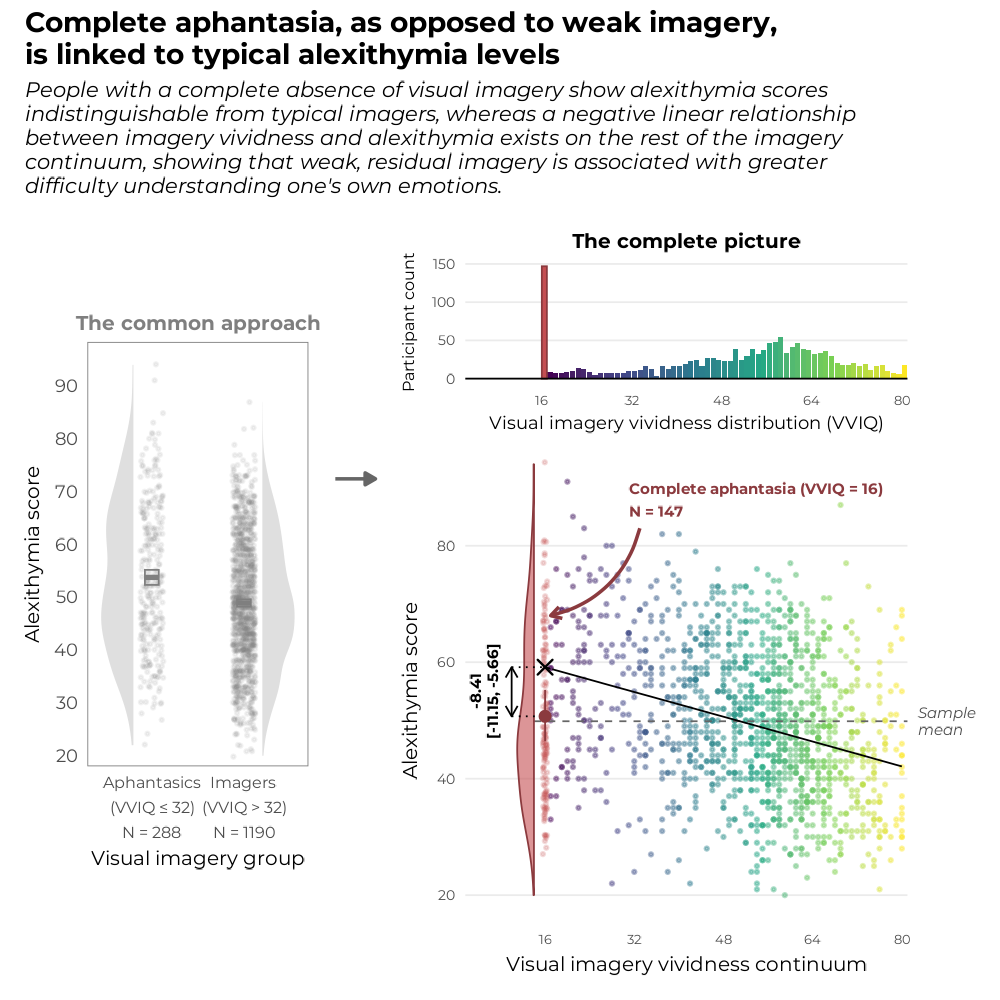
What exactly is in this R package?
The package includes the raw data used in the analyses in the form of a built-in dataset called all_data to make it easily accessible and reusable. This table is the combination of two original, previously unpublished datasets, and three datasets from previous studies, namely Ale & Burns (2024), Monzel et al. (2024) and Kvamme et al. (2026). The package comes with a set of functions for manipulating the data and reliably reproducing the analyses presented in the article.
Beyond the article itself, this project’s full history and analyses are documented as an Extended Online Report (EOR): a structure of interlinked, executable pages that go well beyond what a traditional paper’s Methods and Results sections can show — the reasoning behind each modelling choice, the exploratory work that didn’t make it into the manuscript for space, and the historical process that produced the finding in the first place. Where the article is a summary, the EOR is the full account. It is organised as follows:
- How this study found its shape: the discovery process, dataset by dataset, told as it actually happened.
- Sample description: a closer look at the five pooled datasets.
- Model comparison: how a naive threshold, a categorical grouping, and several continuous models were compared, including a direct comparison against Kvamme et al. (2026)’s own published approach.
- The floor-group model, in depth: the study’s central finding, its statistical evidence, and how it holds up once study-level heterogeneity is accounted for.
- For those who come after: promising directions this project didn’t have time to pursue fully.
-
Codebook: a page documenting every column in
all_datain depth. - Model diagnostics: a technical page reporting all diagnostic checks computed on the study’s fitted models.
- Superseded models: an archive of the results of the 4-group and GAM models that were originally the study’s main models, before model comparison preferred new models inspired by peers.
- Implementation notes: technical details about model design, fitting and reporting.
If you’d rather get straight to using the package yourself, the Get Started page is a short, practical introduction to the data and the core functions.
The source code of every page above is available in the vignettes/ folder of the package repository.
Installation
You can install the development version of aphantasiaEmotions from GitHub with:
# install.packages("pak")
pak::pak("m-delem/aphantasiaEmotions")
Alternatively, you can clone the repository, launch the R project in RStudio by opening the aphantasiaEmotions.Rproj file and run the following command:
devtools::load_all()
#> ℹ Loading aphantasiaEmotions
#> Welcome to aphantasiaEmotions.
… Which will load the package and make all its functions and data available in your R session.
Citation
This GitHub repository is archived in the OSF project, which allowed to assign a permanent DOI to the code and data. Thus, if you use this code or data in your research, please cite the OSF project with the following:
Delem, M. (2026). “Supplementary materials for ‘Complete Aphantasics Are No More Alexithymic Than Typical Imagers’.” https://doi.org/10.17605/OSF.IO/B837S.